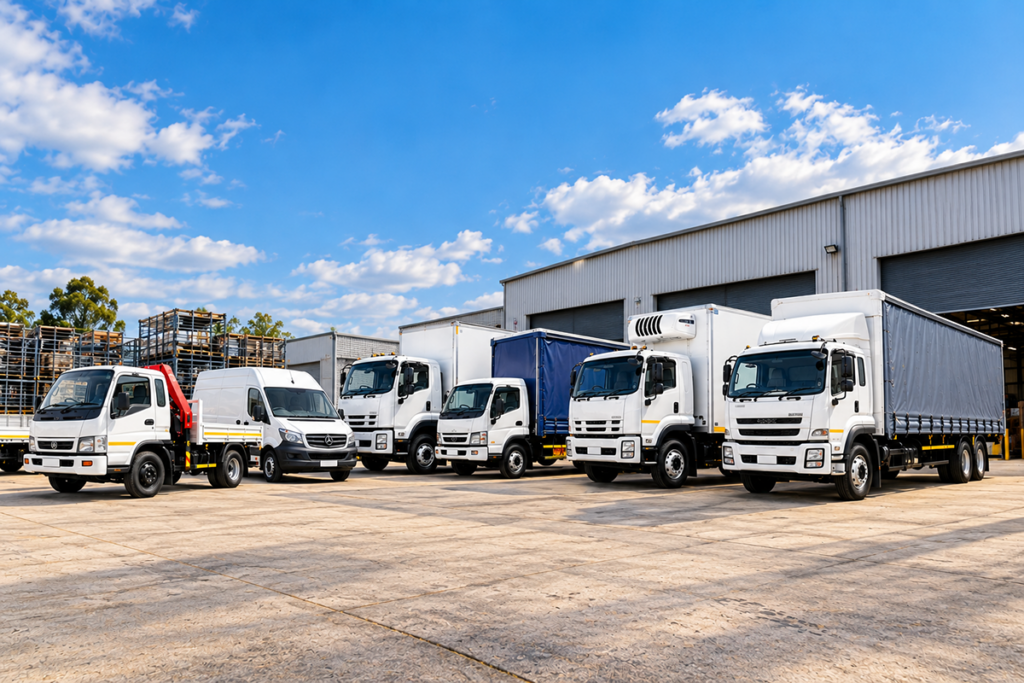
Most people choose a vehicle based on a rough guess. If you go too small, you end up doing two trips, or worse, overloading. If you go too big, you’re paying for empty space and might need a licence you don’t have.
Matching your load to the right vehicle isn’t complicated once you know what to look at.
Start with two questions: how heavy, and how bulky?
Every load has a weight and a volume, and either one can be the limit.
A couch, a fridge and a few mattresses don’t weigh much, but they take up a lot of space. Bricks, cement and tiles are the opposite: they’re compact, but they can push a vehicle past its weight limit long before it looks full.
The “ton” figure you hear on bakkies and trucks usually refers to payload: how much weight the vehicle can legally carry. Keep that number in mind for heavy loads, and think about floor space and height for bulky ones.
Bakkies: small loads and quick trips
A 1-ton single cab bakkie is the workhorse for everyday jobs. It’s ideal for:
- a few appliances or pieces of furniture
- garden refuse
- small quantities of building material
- a student moving out of res
It has an open load bin, so bring a tarp and rope if there’s any chance of rain.
If you need more protection or a bit more capacity, there are a few other options:
- Volumetric bakkies have a covered, higher load area. They’re good for boxes, stock and furniture that needs to stay dry.
- Super tonners and the Hyundai H100 carry a little more than a standard bakkie. Small businesses doing daily delivery runs use them a lot.
- Refrigerated bakkies handle smaller loads of perishable goods.
You can see the full range on our bakkie hire page.
Vans: when your load needs to stay dry and secure
A panel van is fully enclosed and lockable. That makes it the better choice for parcels, retail stock, electronics, or anything you’d rather not have on display.
Vans also work well for multi-drop deliveries, where you’re in and out of the vehicle all day. Take a look at our van rental options if this sounds like your kind of load.
Trucks: house moves and bigger commercial loads
Once you’re moving a household or a serious amount of stock, you’re in truck territory.
- A 4-ton truck usually handles a typical two- to three-bedroom home. It also suits a business moving equipment, stock or pallets.
- An 8-ton truck is for larger homes, office moves and bigger commercial loads. It’s the size that turns two trips into one.
You can browse the full truck rental fleet. If you’re planning a household move, our moving truck rental page covers what you need to know.
Some loads need a specialised vehicle:
- If you’re transporting perishables in volume, look at refrigerated truck hire.
- For heavy items that can’t be lifted by hand, such as machinery, containers or generators, a crane truck does the lifting for you.
Quick reference: which vehicle fits your load?
| What you’re moving | Usual fit |
|---|---|
| A few appliances or furniture items | 1-ton bakkie |
| Garden refuse or small building supplies | 1-ton bakkie |
| Boxes or stock that must stay dry | Volumetric bakkie or panel van |
| Daily small-business deliveries | H100, super tonner or panel van |
| Bachelor or one-bedroom flat | Panel van or 4-ton truck, depending on furniture |
| Two- to three-bedroom house | 4-ton truck |
| Four-bedroom house or office | 8-ton truck |
| Perishable goods | Refrigerated bakkie or truck |
| Heavy items that need lifting | Crane truck |
Don’t forget the licence
This is where many people get caught out.
A Code B licence covers vehicles up to 3,500 kg GVM (gross vehicle mass). That includes bakkies and most vans. Anything heavier needs a Code C1 licence, which used to be called Code 10.
The “4-ton” in a 4-ton truck refers to payload, not total weight. Once you add the weight of the truck itself, you’re well above 3,500 kg, so a normal car licence won’t cover it.
Our guide on what licence you need to drive a hired truck explains this in more detail. If you don’t have the right code, you can hire the vehicle with one of our drivers.
For private bakkie hire, self-drive is available on rentals of five days or longer. Shorter rentals come with a Dial-A-Truck driver.
Tips for getting the size right
- List your biggest items first. The large pieces decide the vehicle; the boxes fill the gaps.
- Measure the largest item. Check door widths and stairways at both ends as well.
- Estimate weight for heavy loads. A bag of cement is 50 kg, and twenty bags is already a full ton.
- If you’re stuck between two sizes for a house move, go bigger. A second trip costs you more in time and fuel than the difference in vehicle size.
- Ask us. Tell us what you’re moving and we’ll recommend a vehicle.
Frequently asked questions
Can I fit a double bed in a 1-ton bakkie?
Usually, yes. The mattress and base fit in the load bin, but cover them well because the bin is open.
Is a van or a bakkie better for deliveries?
A van is better if your goods need to stay secure and dry. A bakkie is the better choice for bulky, dirty or awkwardly shaped loads.
What size truck do I need for a three-bedroom house?
A 4-ton truck handles most three-bedroom moves. If the house is well furnished, with a lot of large furniture and appliances, an 8-ton truck may save you a second trip.
Do I need a special licence to drive a 4-ton truck?
Yes. You need a Code C1 licence. If you don’t have one, you can hire the truck with a driver.
Still not sure?
Tell us what you’re moving and where it’s going, and we’ll point you to the right vehicle. Call us on 0861 998 887, email info@dialatruck.co.za, or request a quote.
Our team is available Monday to Friday, 08:00 to 17:00.